Tariff Blog Series: Exploring Alternatives to Traditional Sorters
September 12, 2025 By: David K. Teeple | Topics: Supply Chain, Tariffs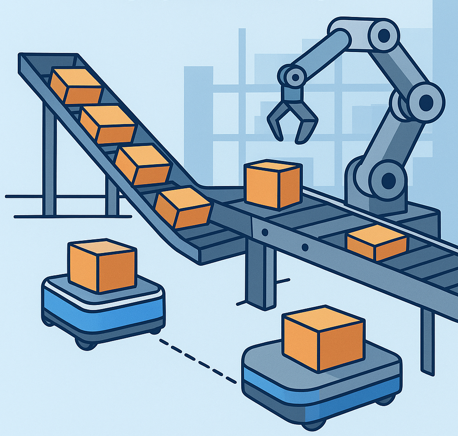
By Daniel Hyla & Dave Teeple
Distribution centers have long relied on traditional sortation systems such as tilt tray and cross-belt sorters. These technologies, first developed in the mid-20th century, were designed to automate the high-volume sorting of uniform items into specific destinations. Their early adoption in parcel handling, retail distribution, and catalog fulfillment dramatically improved accuracy and throughput, reducing the reliance on manual labor and enabling scale. Over time, these systems became the backbone of large, high-throughput distribution centers.
Traditional sorters work exceptionally well in environments with steady, predictable order flows. However, today’s supply chains look very different from those of decades past. Retail distribution often focuses on full-case or bulk replenishment, while e-commerce requires item-level precision and a far more diverse order profile. Increasingly, businesses are blending channels through omni-channel strategies, which place even greater stress on sortation systems by requiring them to handle a wide mix of volumes, packaging, and service levels simultaneously. Rising shipping costs are another driver for increasing shipment precision and accuracy. This blending of channels often results in less-than-optimal utilization of equipment, as systems designed for one type of flow are stretched to accommodate others.
Traditional sortation systems are expensive to purchase and operate, so high utilization is critical to making the business case work. Traditional systems often require careful synchronization between manual labor and automation, creating potential operational bottlenecks. This reliance on efficient use makes utilization one of the most critical aspects of running a successful sortation operation, but also one of the most difficult to achieve.
Scalability is another persistent limitation. Traditional tilt tray and cross-belt sorters are large, capital-intensive systems that are difficult to expand incrementally. Once designed and installed, capacity is relatively fixed, leaving operators with few options to adjust to changing business needs without significant reinvestment or disruption. In an era where demand patterns shift rapidly and unpredictably, the inability to easily scale up or down represents a significant drawback.
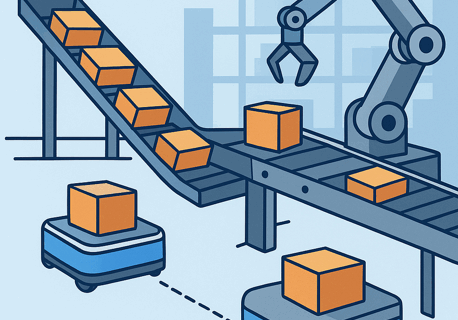
In response to these challenges, alternative sortation technologies are gaining traction. Robotic systems, that include autonomous mobile robots or robotic arms, offer more flexible movement opportunities. Instead of relying on centralized points, robots can be deployed across the operation, distributing the workload and avoiding chokepoints. This not only improves utilization but also allows operators to scale capacity by simply adding more robots as demand grows. Similarly, modular conveyor-based systems and reconfigurable sorters allow facilities to adjust pathways, destinations, or system layouts with far less downtime than traditional equipment. These systems are well-suited to omni-channel operations, where distribution centers need to accommodate both case-based retail replenishment and item-level e-commerce fulfillment without committing to a single, rigid configuration.
Technological advancements have also enabled intelligent sortation solutions. Sensor technology, computer vision, and artificial intelligence allow these systems to track items in real time, optimize routing, and adjust dynamically to changing conditions. Machine learning algorithms can analyze historical and real-time data to predict bottlenecks, optimize order sequencing, and improve sorting accuracy over time. These capabilities enable distribution centers to operate more efficiently, maintain high throughput, and adapt quickly to sudden changes in volume or product mix. Automating much of the decision-making enables these systems to mitigate the traditional challenge of utilization, helping businesses achieve higher efficiency and a stronger return on investment.
The advantages of these alternative systems are clear. They provide the flexibility to handle both retail and e-commerce flows, as well as omni-channel mixes, without requiring separate, dedicated systems. They improve utilization by empowering flexibility more evenly across the operation, reducing reliance on a few critical choke points. They scale far more effectively than traditional sorters, allowing operators to add modules, robots, or system extensions as demand grows, rather than making large, one-time investments. And they provide adaptability, giving facilities the ability to respond to changing order profiles, new product types, and seasonal peaks while maintaining sorting accuracy.
While tilt-tray and cross-belt systems once defined efficiency, their fixed footprints rely on sizing infrastructure generally around 10-year growth projections — often resulting in over-investment or underutilization when demand shifts. They also introduce operational risks: a single point of failure can halt the entire sorter, while SKU exceptions (oversized, rolling, or very small items) still require labor-intensive manual handling. Over time, these limitations translate into higher maintenance costs and slower adaptability.
Robotic sortation, by contrast, eliminates many of these constraints. Modern systems process majority of SKUs with no manual exception handling, reduce significant labor requirements, and operate in much smaller footprints of traditional sorters. Their modular design allows operators to add capacity incrementally, avoiding the disruptive, all-or-nothing investments associated with tilt-tray replacements. Equally important, distributed reliability means no single breakdown can take down the system, ensuring continuous operation even during peak demand. The result is faster ROI, along with annual labor savings and the flexibility to grow alongside the business.
While traditional systems continue to serve many facilities well, alternative solutions are increasingly attractive because they not only meet the core requirements of sortation, enabling accurate & high-throughput distribution of items to their correct destinations, but also provide operational agility. By addressing the long-standing weaknesses of channel rigidity, bottlenecks, and limited scalability, alternative sorters create a more resilient and future-ready fulfillment model. As currently deployed traditional sorters reach end of life, we anticipate a general migration in the market to more advanced, flexible solutions.