Navigating the Tariff Storm Part XIV: Rethinking Network Strategy to Navigate Global Tariff Disruptions
August 14, 2025 By: Michael L. Davis | Topics: Network Strategy, Tariffs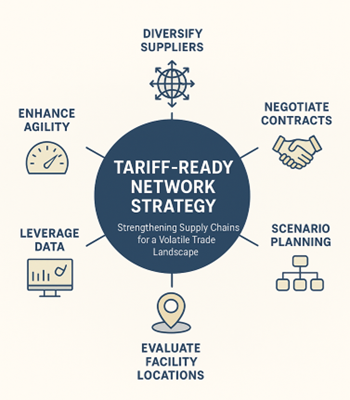
By Daniel Hyla and Michael Davis
Tariffs have continued to disrupt global trade, paralyzing many supply chains. As costs rise and uncertainty persists, networks are under scrutiny as organizations search for ways to minimize impact. Leveraging existing partnerships, finding alternative suppliers, and forging new relationships are proven strategies to build agility and flexibility into the supply chain. Waiting for conditions to stabilize is risky as delays can erode market share, weaken competitive advantage, and shrink margins, delivering potentially devastating blows to an organization. Building on previous posts (Surviving Tariff Turbulence – What to Do Now & Trade Policy Update) where we briefly explored opportunities for strengthening supply chain networks, this article dives into specific actions across different parts of the network to enhance resilience and agility, ensuring all aspects of your organization are prepared to withstand and adapt to tariff disruptions.
A supply chain network encompasses all touchpoints, both geographic and physical, through which materials move from raw inputs to finished goods. This often includes sourcing, manufacturing, distribution, and delivery to customers, whether in-store or online. When tariffs were first introduced in April, most networks remained relatively unchanged unless a major business model shift occurred. Organizations often focused on micro-level adjustments, such as renegotiating prices, to maintain stability. But as tariffs expanded, uncertainty spread through entire supply chain ecosystems. Addressing these challenges requires a combination of strategic sourcing, proactive relationship management, and forward-looking operational planning. The following approaches can help organizations strengthen their networks and reduce vulnerability in a volatile trade environment.
Data is the backbone of a strong supply chain strategy. Equipping teams with accurate, timely, and comprehensive information is the first step toward identifying opportunities within your network. Historical trends, forecasts, and cross-functional data should be consolidated and made accessible so teams can act decisively. Key metrics including cost, service levels, risk exposure, inventory impact, product flow, and capacity must be evaluated to uncover actionable steps that improve agility, reduce risk, and sustain competitive advantage.
Building on this foundation of data-driven insights, supplier diversification emerges as one of the most effective ways to reduce tariff exposure. Relying heavily on a single country, particularly one facing high tariffs, creates concentrated risk that can ripple through the entire network. Organizations should actively assess sourcing strategies to reduce dependence on these regions, while increasing procurement from countries with lower or no tariffs. Beyond shifting international sources, many companies are finding value in nearshoring (moving production closer to the home market), friendshoring (sourcing from politically aligned nations), and reshoring (bringing operations back domestically). These strategies not only reduce tariff costs but also shorten lead times, improve responsiveness, and enhance resilience to geopolitical or logistical disruptions.
While supplier diversification addresses long-term sourcing risks, immediate relief can come through strategic contract renegotiation. Long-standing supplier relationships are a powerful tool in times of volatility. Organizations can leverage their history and volume commitments to secure better pricing, extended payment terms, or shared tariff burdens. Proactive, transparent conversations with suppliers about the mutual impact of tariffs can lead to creative solutions such as cost-sharing agreements, flexible minimum order quantities, or temporary adjustments to service levels. These negotiations can soften the short-term financial impact while preserving critical partnerships for the future.
Beyond supplier relationships, modelling and simulating scenarios is another tool to help make strategic and informed decisions that can significantly impact both costs and operational efficiency. Organizations should run simulations that consider the cost and operational implications of relocating, expanding, or downsizing facilities. This includes modeling various tariff scenarios, transportation costs, labor availability, fixed and variable operational costs, and service-level impacts. For some, expanding capacity in lower-tariff regions may offer competitive advantage; for others, consolidating operations or shifting to a smaller, more agile footprint might be the optimal path.
Finally, evaluating facility locations can uncover significant hidden opportunities that many organizations overlook in their focus on both upstream and downstream in the supply chain. The physical placement of warehouses, fulfillment centers, and cross-docking facilities has a direct effect on transportation costs, delivery times, and tariff exposure. By mapping current distribution nodes against tariff zones (Free Trade Zones and Foreign Trade Zones), customer demand centers, and supplier origins, organizations can identify whether repositioning facilities or adding new ones could reduce costs and improve service. In some cases, relocating a distribution hub just across a border can drastically change tariff obligations and logistics efficiency.
In a climate where tariffs are reshaping the competitive landscape, supply chain agility is no longer optional, it’s a strategic imperative. Organizations that act decisively now, using data to guide diversification, negotiation, and network optimization, will be better positioned not only to weather the current disruptions but to emerge stronger, more resilient, and ready for future challenges.
At Sedlak, we understand the challenges of supply chain and network strategy. Network optimization is one of our core competencies and integral to our firm, comprising 25-30 percent of our business. State of the art tools including OptiLogic’s Cosmic Frog, Insight Supply Chain Optimizer formally SAILS, and proprietary Excel and Access based files are tools that Sedlak utilizes to bring unique, creative solutions that challenge the status quo. Our comprehensive analysis addresses each client’s entire business and optimizes for cost, service levels, risk, impact on inventory, product flow and capacity in support of long-term growth.
Let Sedlak assist you in addressing these challenging times. With over 65 years of experience advising industry leading organizations, Sedlak will help you prepare for an ever-evolving future. Reach out to David Teeple at dteeple@jasedlak.com or Michael Davis at mdavis@jasedlak.com for more information.