Navigating the Tariff Storm Part IX: How the Global Trade War is Heating Up
July 11, 2025 By: David K. Teeple | Topics: Supply Chain, Tariffs
By Daniel Hyla and David Teeple
The tariff-related winds picked up momentum this week as the Trump administration issued formal letters to countries that have yet to finalize trade agreements with the United States. On Wednesday, July 9th, the expiration date for the reciprocal tariffs imposed on April 2nd — known as “Liberation Day” — passed, prompting the administration to reassert its tariff strategy.
While the revised tariff rates announced in these letters did not catch many by surprise — they remain in the same range as the original April 2nd figures — the message was clear: countries that have not agreed to new trade terms will continue to face steep tariffs.
When the reciprocal tariffs were first introduced, many drew parallels to The Art of War, interpreting the administration’s actions as a calculated maneuver to shift global trading leverage toward the U.S. Over the past few months, countries and multinational businesses have attempted to navigate around the tariffs, seeking exemptions, restructuring supply chains, or even pursuing legal recourse. Notably, some small businesses have challenged the legality of the tariffs in court, with the U.S. Court of International Trade ruling aspects of the implementation unlawful.
White House spokesperson Emily Kush responded to growing resistance by stating, “The United States — the world’s biggest and best consumer market — holds the cards and leverage in negotiations to unilaterally set deals with appropriate tariff rates for our trading partners.”1
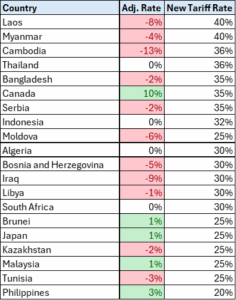
This week, the administration further revealed its negotiating position through the newly dispatched tariff letters. The chart below shows the updated tariff rates announced earlier this week compared to the original April 2nd measures.2
In parallel with these announcements, the administration also introduced a new 50% tariff on copper imports. This move is particularly notable given that copper (primarily sourced from Chile, Canada, Peru, and Mexico) is a critical material in semiconductors, automotive components, household appliances, and electrical systems. The copper tariff adds to a growing list of country- and product-specific trade restrictions rolled out in recent weeks.
These actions reaffirm the administration’s determination to shrink the U.S. trade deficit, which officials argue has long undermined domestic economic resilience. However, critics are raising alarms. Jake Colvin, President of the National Foreign Trade Council, commented: “The President’s strategic uncertainty is producing some short-term results, but continuing to threaten exorbitant tariff rates is paralyzing for business decision-making and erodes trust with our allies and major trading partners.”
Despite the sweeping policy changes, consumer confidence has remained largely stable in recent months. This stability may be temporary, as many companies have front-loaded shipments and built up inventories in anticipation of rising costs. However, with roughly three months passed since the initial wave of tariffs, those buffers are thinning and the long-term impacts may soon begin to surface.
With the administration reinforcing its stance on tariff policy this week, supply chain leaders must continue prioritizing resilience and agility. Organizations that take a “wait and see” approach will likely face mounting volatility across all facets of their supply chain, from sourcing and procurement to warehousing and distribution. Proactive planning is essential. This includes diversifying supplier bases, renegotiating contracts, exploring Free Trade Zones, Foreign Trade Zones, and Bonded Warehouses, as well as investing in automation and advanced logistics technologies including tariff simulation tools. By adopting these strategies, supply chain leaders can help their organizations better absorb tariff-related disruptions and position themselves for long-term stability amid an increasingly unpredictable trade environment.
Let Sedlak assist you in addressing these challenging times. With over 65 years of experience advising industry leading organizations, Sedlak will help address the challenges of today and prepare you for an ever-evolving future. Reach out to Dave Teeple at dteeple@jasedlak.com or Daniel Hyla at dhyla@jasedlak.com for more information.