Tariffs Blog Series: Navigating the Future of Inventory Management – A 2025 Playbook
August 20, 2025 By: David K. Teeple | Topics: Supply Chain, Tariffs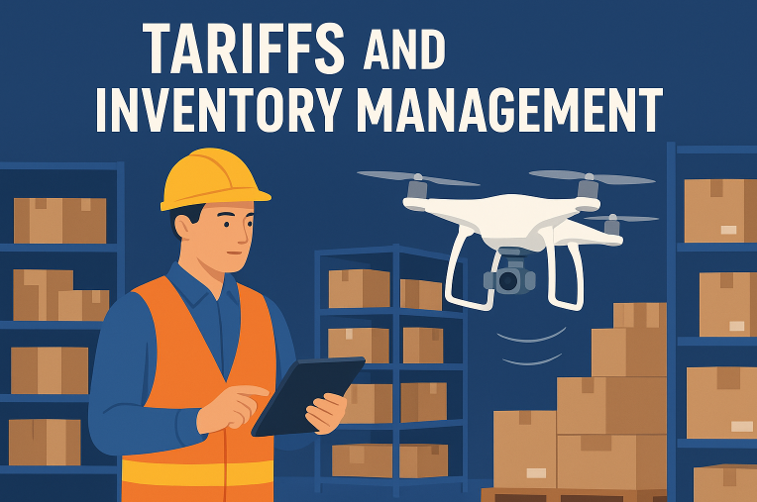
By Daniel Hyla and David Teeple
Inventory Management often sits at the crossroads of success and failure in today’s volatile supply chain. When it is well managed, it enables organizations to meet customer demand, maintain service levels, and control costs. When it is not, the consequences ripple across the entire supply chain, from manufacturing to distribution to customer satisfaction. The introduction of tariffs into global trade dynamics has added another layer of complexity, forcing businesses to rethink how they balance inventory strategies.
Inventory imbalances can tilt in either direction, each bringing its own set of problems. Holding too much inventory can be just as damaging as holding too little. For industries such as pharmaceuticals or food, overstocking carries the risk of expiration and waste. In retail and seasonal categories, unsold goods quickly become obsolete, leaving businesses with sunk costs and clearance sales that erode margins.
On the other hand, understocking often proves equally costly. Not having enough inventory on hand can jeopardize meeting service level agreements (SLAs) and customer expectations. Shortcomings, should they materialize, are usually filled with expensive expedited shipments, which may solve the immediate problem but steadily chip away at profitability. In a tariff-heavy environment where every percentage point of cost matters, these kinds of inefficiencies can be particularly painful.
One recent trend driven by tariffs has been front-loading inventory, bringing goods into distribution networks ahead of tariff hikes to avoid added costs. While effective in dodging short-term expenses, this strategy led to swelling stockpiles and heightened storage costs. Companies that were once accustomed to lean operations suddenly found themselves grappling with warehouse capacity constraints and more complex inventory management challenges.
This shift reignited debate between two well-known strategies: Just in Time (JIT) and Just in Case (JIC).
- JIT focuses on efficiency, keeping inventories lean and replenishing only when needed. Popularized by lean manufacturing practices, it reduces waste but leaves businesses exposed to disruptions.
- JIC emphasizes resilience, holding higher levels of inventory as a buffer against disruptions such as tariff changes, natural disasters, or supplier delays. While more risk averse, this approach ties up capital and increases carrying costs.
With increased inventory levels come operational challenges. Dense warehouses with overflowing stockpiles heighten the risk of shrinkage, misplaced goods, and reduced accuracy in inventory records. Each additional pallet requires more time, money, and labor to track, count, and manage effectively.
That is why inventory accuracy has emerged as a critical focus area. Even small discrepancies between what is recorded in systems and what is physically on hand can lead to costly errors in fulfillment, production planning, and financial reporting.
To address these challenges, organizations are increasingly turning to technology. Warehouse automation tools have evolved rapidly in recent years, and one promising innovation is the use of drones for inventory management.
Organizations across many industries are increasingly adopting drone and robotics solutions for automated inventory management in high-density warehouses. Drone technology enables autonomous counting, allowing organizations to continuously monitor and verify stock without the downtime and cost of manual counts. Equipped with cameras, drones can navigate high racks, taking pictures of locations. These pictures are then analyzed by machine vision in the cloud to find empty pallets or misplaced inventory as well as performing counts and other tasks, synching physical and systemic inventory. The result is a more accurate, up-to-date picture of inventory levels with fewer errors and less reliance on manual labor. Fewer errors equates to less time spent trying to find misplaced inventory and the ability to ship on time and in full (OTIF).
By adopting drone-enabled cycle counting, businesses not only improve accuracy but also gain the agility to respond more effectively to tariff-induced disruptions. Whether stockpiling to mitigate costs or leaning back toward JIT practices, accurate inventory data ensures organizations can make confident, informed decisions.
Tariffs have rewritten the playbook for inventory management. Companies must now walk a fine line between resilience and efficiency, ensuring they can absorb disruptions without overburdening themselves with excess costs. Too much inventory wastes capital and space, while too little undermines service and customer trust.
As the debate between JIT and JIC continues, one constant remains: the need for precise, reliable inventory data. Emerging technologies such as drone automation are helping businesses bridge that gap, allowing them to manage the risks of higher inventory levels while remaining agile in the face of global uncertainty.
In a world where tariffs and trade policies can shift overnight, inventory management has become more than just an operational function – it is a strategic lever for resilience, cost control, and long-term competitiveness.
Let Sedlak assist you in addressing these challenging times. With over 65 years of experience advising industry leading organizations, Sedlak will help you prepare for an ever-evolving future. Reach out to David Teeple at dteeple@jasedlak.com or Daniel Hyla at dhyla@jasedlak.com for more information.